

There comes a season in the life of every political party when truth finally demands an answer, when silence becomes treason, and when evasion is no longer a strategy but a confession of guilt. For the All Progressives Congress in Kogi State, that season has arrived. 2027 is no longer a date on the calendar; it is a mirror held up to a party that must now decide whether it was established to serve a diverse state or to preserve the wreckage of Yahaya Bello’s dynasty—a dynasty built on entitlement, enforced through fear, and defended with a shamelessness that insults the intelligence of every citizen of Kogi.
For thirty-three staggering years, Kogi West has been denied what every democratic system considers basic fairness: the right to produce a governor in the state that was carved out of its own historical territory. Three decades of exclusion is not an accident; it is not a political misunderstanding; it is not an administrative oversight. It is a deliberate architecture of injustice, engineered and protected by those who mistake electoral victory for a royal charter. Kogi West, with over 1.3 million citizens, remains the only senatorial district in Nigeria that has been denied the governorship of its own state for thirty-three straight years — a record of exclusion unmatched anywhere else in the federation. No democracy survives on that kind of imbalance. No political party can command loyalty while sustaining such brazen inequality. And no region can be asked to wait for thirty-three years without eventually demanding what is rightfully its own. The Constitution does not mandate zoning, but it recognises equity and federal character as the pillars that protect diverse societies from dominion — principles APC nationally claims to uphold but has repeatedly violated in Kogi.
Across Nigeria — from Enugu to Cross River, from Delta to Zamfara — governorship rotation has sustained peace, legitimacy, and party stability. Kogi remains the only state where one district has monopolised power for over three decades while calling it democracy. The rest of the country moved forward; only Kogi was held hostage.
But Yahaya Bello did not merely inherit this imbalance—he maximized it. He hardened it. He converted it from unfairness into a personal empire. For eight uninterrupted years, power did not just sit in one district; it sat in one ward. And when those eight years expired, power was handed to yet another person from the same ward, as though Kogi State were a family estate inherited through bloodlines. Before the ink of that insult could dry, Bello stood before the world and boasted that he alone would decide the next governor—after sixteen straight years of suffocating political centralization. This was not democracy; this was a private kingdom masquerading as a state. It was not governance; it was an occupation disguised as administration.
And for those now campaigning that His Excellency Governor Usman Ododo should be granted a second term, let us be honest about what that logic truly means. A “second term for Ododo” is not Ododo’s second term at all — it is the fourth consecutive governorship term for one Local Government. Yahaya Bello held the office for 8 years, handed it to another person from the same LGA for another 4, and now they want an extra 4 on top of that. This is not continuity; it is political monopoly disguised as governance. No democratic state can survive this level of concentrated control without collapsing under the weight of its own injustice.
And now, in a twist soaked in hypocrisy, those who never negotiated with anyone during their own accumulation of power now insist that Kogi West must negotiate before 2027. The same people who transferred leadership from one brother to another inside a single ward suddenly wanted dialogue. The same individuals who placed the political future of over three million citizens inside a family conclave suddenly claim to be apostles of consensus. This is not a strategy; it is revisionist audacity. This is not wisdom; it is an attempt to launder the sins of yesterday with the language of today.
This is precisely why Distinguished Senator Sunday Steve Karimi has become a target of coordinated attacks. Karimi’s offence is simple: he refuses to worship at the altar of falsehood. He rejects the doctrine that injustice becomes legitimate once the beneficiaries raise their voices. He refuses to pretend that thirty-three years of exclusion can be explained away by propaganda. If Karimi had chosen betrayal, the red carpet of the dynasty was ready to roll out for him. They had the familiar offerings prepared: appointments, closeness to power, silence packaged as reward. But Karimi rejected all of it because he understands that truth is not negotiable, equity is not a favour, and a people long denied must not be deceived into eternal waiting.
Karimi’s position terrifies the old order because it is grounded not in emotion but in constitutional reality. It is anchored not in ethnic sentiment but in historical truth. It is driven not by personal ambition but by structural correctness. And what those invested in the dynasty now fear most is that Karimi has awakened a political consciousness in Kogi West—one that refuses to apologise for demanding justice, refuses to be intimidated into silence, and refuses to be manipulated into accepting another fraudulent postponement of their democratic right.
What truly destabilises the dynasty, however, is the new alliance between Kogi West and Kogi East—an alliance Karimi openly affirmed at Kabba Cultural Day. This partnership is a nightmare for those who thrive on division, suspicion, and misinformation. Their political machinery collapses when East and West unite because their entire formula depends on keeping the state fractured enough for one ward to dominate all. Once Kogi East and Kogi West recognise their shared interest in justice, the spell is broken. No clique, no cabal, and no dynasty can overpower a united people. This struggle is not against Kogi Central; it is against the capture of Kogi Central by a single household. The people of Central remain our brothers and partners in justice — and many of them, quietly or openly, also reject the dynasty that has embarrassed their district and diminished its democratic dignity.
Nigeria’s national political history offers a clear warning. The PDP’s collapse was not about policy or ideology; it was a direct consequence of violating the principle of rotation. When a party elevates arrogance above equity, implosion becomes inevitable. When a party mocks fairness, voters revolt. When a party insists on exclusion, cracks widen into chasms. APC in Kogi now stands at that same threshold. If it repeats the PDP error, it will inherit the PDP outcome—fragmentation, rebellion, and the irreversible erosion of loyalty.
2027 is therefore not just another election year; it is the accountability year. It is the year APC must prove whether it is a national party guided by justice or a shrinking franchise leased to a collapsing dynasty. It is the year the party must decide whether to correct a thirty-three-year injustice or to endorse the permanent marginalisation of a whole region. It is the year Kogi must choose between being a state grounded in fairness or a territory auctioned to a single political household. No society that repeatedly rewards injustice can claim to be governed by conscience, and no political party that ignores fairness can pretend to represent a moral community.
APC cannot retain Kogi without Kogi West — not in 2027, not in any year. The numbers are brutal: no party can lose the entire western flank, fracture the east through injustice, and still expect victory. The dynasty may ignore this arithmetic, but Abuja cannot. Elections are not won by sentiment; they are won by coalitions, and the only viable coalition in 2027 is one built on justice.
And let Abuja hear this clearly: if the national leadership of APC fails to correct this imbalance in 2027, it will inherit a fractured Kogi APC incapable of delivering even 40% of its current electoral strength — a self-inflicted wound that no dynasty will be around to repair. The warning is not emotional; it is mathematical, historical, and politically unavoidable.
Kogi West has waited long enough. The exclusions have lasted long enough. The silence has stretched long enough. And the patience of a people denied for three decades has reached its moral limit. There is no mathematics, no negotiation, no propaganda, and no dynasty strong enough to erase the truth: 2027 belongs to equity. 2027 belongs to justice. 2027 belongs to the restoration of balance.
Equity in 2027 is not just about where the governor comes from; it is about resetting Kogi on a foundation of fairness, merit, and shared prosperity so every community—East, West, and Central—can finally rise together.
If APC chooses justice, it will strengthen itself. If it chooses the ruins of Yahaya Bello’s dynasty, it will destroy itself. History will record precisely who stood for the rebirth of Kogi and who clung desperately to a fading empire of one ward.
Kogi West will not wait. Justice will not wait. And 2027 will not wait.
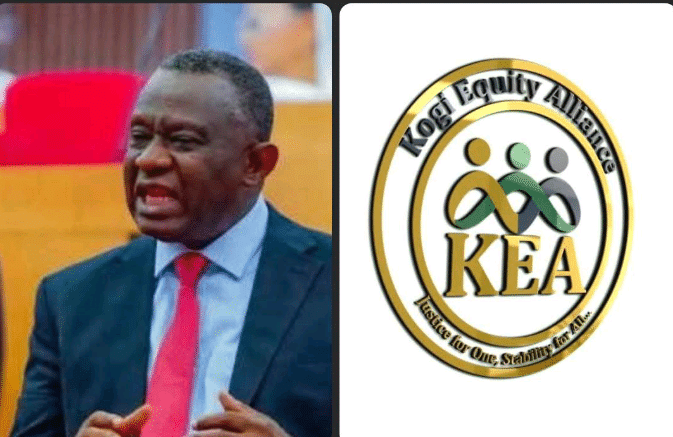
— Written by the Kogi Equity Alliance (KEA)
Yusuf M.A., PhD — Lead Strategist & Policy Architect, KEA.
Because equity is not a favour, it is the foundation of a just and indivisible state.


