

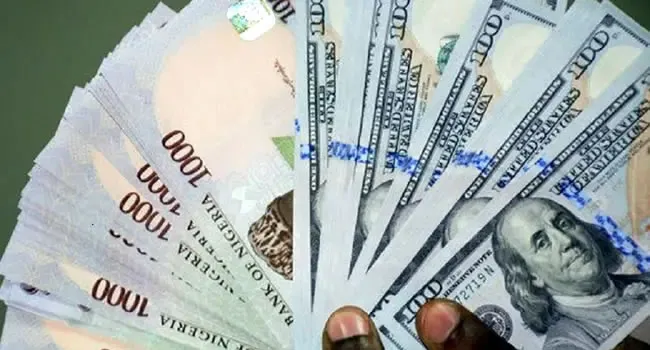
The naira ended January 2026 on a positive note, appreciating against the United States dollar in Nigeria’s official foreign exchange market.
Data from the Central Bank of Nigeria (CBN) shows that the official exchange rate strengthened from ₦1,422.07 per dollar on January 23 to ₦1,386.55 per dollar at the close of trading last Friday, being the 30th of January, 2026.
This represents a 2.47 per cent appreciation within one week.
The naira recorded steady gains from January 26, moving from ₦1,418.95 per dollar to its strongest level of ₦1,386.55 per dollar by the end of the month.
Although the exchange rate briefly weakened to as high as ₦1,423.50 per dollar earlier in the week, the gap between daily highs and lows narrowed, suggesting improved market stability.
The official exchange rate is important because it determines the cost of imports and international payments processed through banks, including school fees and medical bills.

Analysts say continued strengthening of the naira could help reduce inflationary pressure on imported goods.
Cowry Assets Management Limited noted that the naira also gained in the parallel market, appreciating by 2.11 per cent to ₦1,444.19 per dollar.
The firm said the currency is likely to maintain moderate gains, supported by steady oil earnings, stronger non-oil inflows, and a trade surplus.
According to CardinalStone, the naira traded around ₦1,465.00 per dollar in the parallel market.
AIICO Capital reported that the naira appreciated by 1.28 per cent in the parallel market in January, closing at ₦1,460.00 per dollar from ₦1,490.00 per dollar at the start of the month.
RELATED TRENDS:
JUST IN: NLC, TUC Suspend FCT Protest, Ask Workers to Resume Immediately
Court Orders DBI to Pay Former Manager 14 Years’ Benefits
The firm attributed the improvement to better foreign exchange liquidity from foreign portfolio investors, local market players, and limited intervention by the CBN.
AIICO Capital also revealed that Nigeria’s external reserves rose by $687.4 million in January to $46.18 billion, driven by stronger FX inflows, oil receipts, remittances, and ongoing stabilisation measures.
Looking ahead, analysts expect the naira to remain volatile but broadly stable, with modest appreciation in February, supported by strong reserves and high crude oil prices.
However, Bloomberg reports that uncertainty over new tax laws is increasing dollar demand in the parallel market.
A bureau de change operator, Abubakar Muhammed, said some individuals are converting naira to dollars to protect their assets and avoid possible scrutiny from tax authorities.
Confirming this trend, Financial Derivatives Company CEO, Bismarck Rewane, said fears of account restrictions are pushing people to buy and hold dollars for now.
FOLLOW US ON X @ Symfoni (@SymfoniNews) / Posts / …X · SymfoniNews1K+ followers


Comments 2