

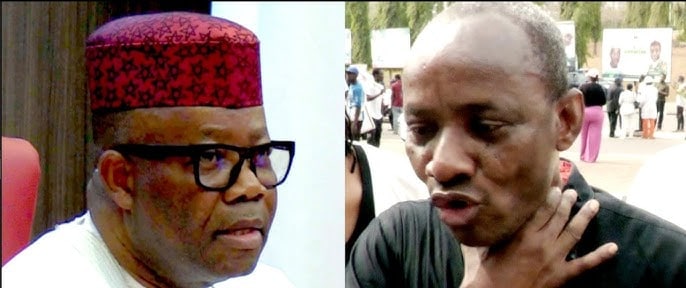
Political analyst and former chairman of the Nigerian Electricity Regulatory Commission (NERC), Sam Amadi, has delivered a scathing assessment of Nigeria’s National Assembly, describing the Senate as “worse than a rubber stamp” during the ongoing #OccupyNASS protest in Abuja.
Speaking to Symfoni at the protest ground, Amadi said the demonstration should not be judged by the number of people physically present, but by the widespread national support behind it. According to him, Nigerians across the country — in their homes, offices, and communities are mentally and emotionally invested in the protest because it touches the very foundation of democracy.
“This is not an ordinary protest,” Amadi said. “It is a nation asserting its right to be seen, to be safe, and to have a voice.”
He explained that despite worsening living conditions, insecurity, and the collapse of public services, Nigerians still cling to hope through the ballot.
The analyst noted that hospitals have been reduced to little more than consulting centers, while preventable deaths, including snake bites, continue to claim lives. Yet, he said, citizens remain committed to democracy because they believe elections offer a peaceful path to change.
According to Amadi, the core demand of the protest is simple: make electronic transmission of election results mandatory by law. He recalled that the Supreme Court had ruled that electronic transmission is not compulsory unless clearly stated in the Electoral Act, advising lawmakers to include it explicitly in the law rather than leaving it to regulations.
“What Nigerians are asking for is straightforward,” he said. “Write into the law what the court has already said. Let electronic transmission be compulsory, so that whoever wins an election, everyone will know the result is credible.”
He further stressed that the protest is not about political parties or candidates. He insisted that it is not a fight between the APC, PDP, or Peter Obi’s supporters, adding that even some senators from the ruling APC privately support the demand. Instead, he argued that resistance comes from a small group of politicians who fear losing power if elections are conducted freely and fairly.
He therefore warned that Nigeria risks serious consequences if democratic credibility continues to decline. Drawing comparisons with Mali, Niger, and Burkina Faso, Amadi said many military coups in West Africa were triggered by disputed elections and the concentration of power in the hands of a few elites.
“Nigeria is too big to fail,” he warned. “If democracy collapses here, it will be a major human development disaster.”
Addressing the presence of soldiers around the National Assembly during the protest, Amadi said the deployment reflects misplaced priorities. He stressed that soldiers do not act on their own but follow orders from the highest authorities. According to him, many troops would rather be deployed to protect citizens from violent attacks than to monitor peaceful protesters.
“The fact that soldiers are here tells you where the priorities are,” Amadi said. “Lives are being lost across the country, yet the focus is on controlling protests instead of protecting citizens.”
He accused political leaders of caring more about electoral outcomes than the safety of Nigerians, arguing that leaders who believe elections can be manipulated no longer feel accountable to the people. In such a system, he said, leaders stop communicating, apologizing, or pretending to care because citizens’ votes no longer threaten their hold on power.
Amadi further criticized the National Assembly’s handling of electoral reforms, declaring that the Senate has failed in its constitutional role. “A rubber stamp can at least react,” he said. “This Senate is worse. It simply lies there until it is told what to do.”
He concluded by urging lawmakers to listen to the voice of the people and act in the national interest by strengthening electoral laws. According to him, Nigerians may endure poor governance, but they cannot accept a system where elections lack credibility.
“We can survive bad leadership,” Amadi said. “But we cannot survive a failed election. This protest is Nigerians saying: please, let us breathe.”


