

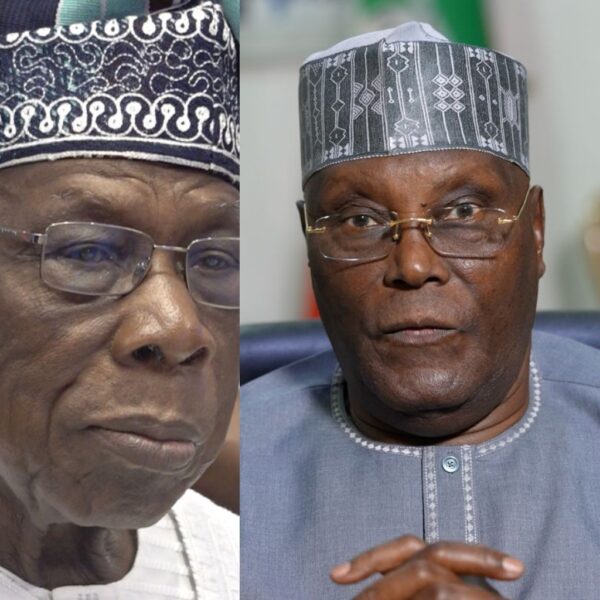
History has a stubborn memory. Documents do not tremble, they do not shift allegiance, and they do not rewrite themselves to suit the politics of revenge. They simply sit there, quietly, waiting to expose hypocrisy.
In February 1999, at the Nicon Noga Hilton Hotel in Abuja, a fundraising dinner was held for the presidential ambition of Chief Olusegun Obasanjo. The event raised about 400 million naira, an enormous sum at the time. The single largest donation came from Alhaji Aliko Dangote, who contributed 120 million naira. The second largest came from Atiku Abubakar and his associates, who donated 80 million naira.
Eighty million naira.
In 1999, that figure was not casual generosity. It was political oxygen. It was structure. It was commitment. It was belief in a joint project. Atiku did not stand at the sidelines; he stood at the financial and political backbone of that campaign.
Obasanjo won. Atiku became Vice President. A partnership was born, forged not just in political convenience but in shared struggle and material sacrifice.
So what changed?
What transformed a trusted ally into a “thief” in the rhetoric of a sitting President?
The answer is neither subtle nor mysterious. It was power. Specifically, the desperate and unconstitutional hunger for a third term.
When the infamous third term agenda began to creep into national discourse, it did not emerge with honesty. It came cloaked in whispers, trial balloons, constitutional gymnastics, and quiet inducements. The Nigerian political class was expected to bow. Many did but Atiku did not.

He stood in opposition to the extension of tenure beyond constitutional limits. He became the most formidable internal obstacle to Obasanjo’s ambition to remain in power. And from that moment, the machinery of state began to turn against him.
What followed was not mere disagreement. It was persecution.
Institutions were deployed. Investigations multiplied. Allegations were amplified. The label “corrupt” was no longer an accusation; it became a weapon. The same man whose financial support had strengthened the 1999 campaign was now painted as a criminal. The same political ally who had stood shoulder to shoulder in victory was recast as a national liability.

One must ask a simple question.
If Atiku was truly a thief in 1999, why was he selected as running mate? Why was he entrusted with economic reforms? Why was he defended in earlier years? Why was his 80 million naira not rejected on moral grounds?
Silence answers.
The truth is uncomfortable. The hostility did not begin with corruption allegations. It began with defiance. It began when Atiku refused to endorse constitutional manipulation. It began when loyalty to the Republic trumped loyalty to one man’s ambition.
Nigeria witnessed a troubling precedent: the personalization of state power. Political disagreement became criminal suspicion. Institutional independence blurred into executive influence. A sitting Vice President found himself politically isolated, attacked, and systematically undermined.
This was not merely a clash of egos. It was a warning about how fragile democratic norms can become when power is concentrated in the hands of a leader unwilling to accept limits.
The irony remains sharp. The 1999 campaign itself symbolized political consensus around ethnicity and elite coordination. Major parties aligned, powerful financiers contributed, and a new democratic chapter was promised. Yet within a few years, that promise was stained by intolerance toward dissent within the very presidency that was meant to strengthen democracy.
History is not sentimental. It records that Atiku Abubakar was central to the financial and political architecture of Obasanjo’s return to power. It also records that when he resisted constitutional overreach, he became the target of relentless attacks.
Whether one admires Atiku or not is beside the point. The issue is principle. Democracies collapse not only when constitutions are suspended, but when leaders weaponize institutions against rivals who insist on constitutional boundaries.
In the end, the third term failed. Nigeria stepped back from the edge. But the scars remain. The episode stands as a cautionary tale about ingratitude, vengeance, and the corrosion of democratic culture.
Power tests character. In 1999, loyalty was celebrated. By 2006, loyalty was demanded. And when it was withheld, punishment followed.
History has written it down. The rest is interpretation.


