

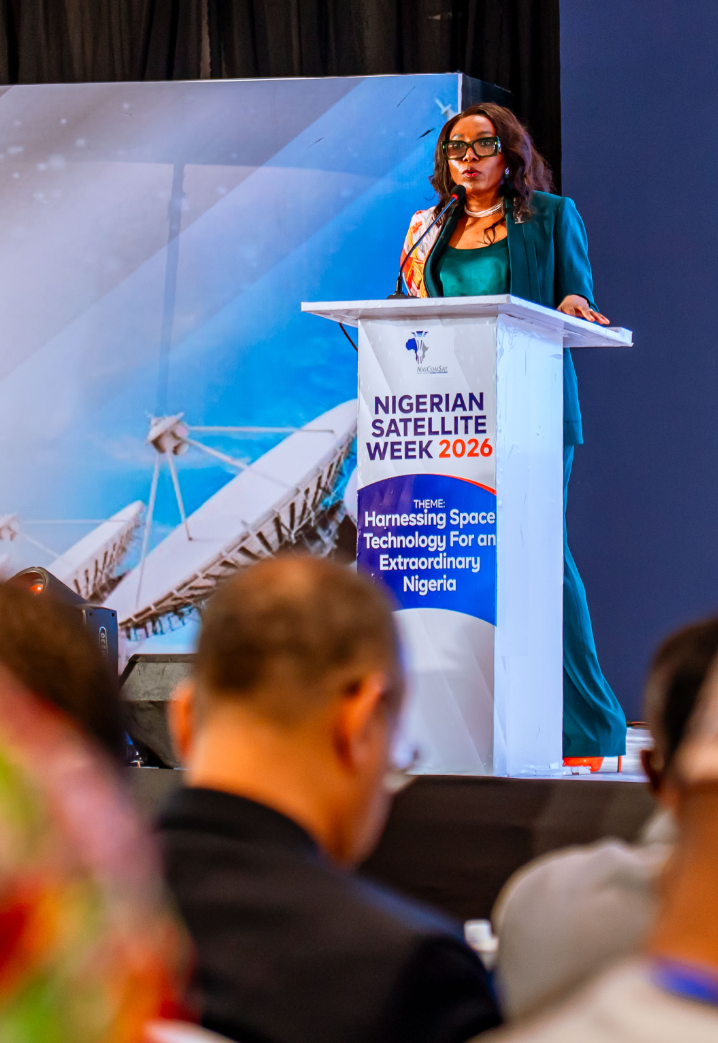
The Managing Director and Chief Executive Officer of (NIGCOMSAT), , has declared that Nigeria’s space economy is already becoming a reality, urging stronger strategic alliances to accelerate the country’s growth in the sector.
Egerton-Idehen made the statement during her remarks on Day Two of the Nigerian Satellite Week 2026 held at the Continental Hotel Abuja.
Addressing government officials, industry stakeholders, innovators and members of the armed forces, the NIGCOMSAT boss said the activities and innovations showcased at the event demonstrate that Nigeria is making real progress in building its space economy.
According to her, Nigerian startups are already developing solutions using satellite technology in areas such as agriculture, logistics, connectivity and digital services.
She said these innovations prove that Nigeria’s participation in the global space industry is no longer just an ambition but an ongoing reality driven by young entrepreneurs and innovators.
Egerton-Idehen explained that building a sustainable space economy requires strong partnerships between government institutions, private companies, innovators and international partners.
She stressed that successful space industries around the world are built on deep and long-term alliances rather than short-term collaborations.
“The question is not whether Nigeria can participate in the global space economy, but how we sustain, scale and institutionalise that participation. The answer is strategic alliance,” she said.
The NIGCOMSAT CEO highlighted key steps already taken by the Nigerian government to strengthen the sector, including the approval of two additional satellites for the national satellite operator by President.

She also pointed to the implementation of Project 774, through which NIGCOMSAT has connected 45 local government secretariats across eight states to broadband services using satellite technology within just two months.
According to her, the project shows how satellite infrastructure can quickly expand internet access to areas where traditional telecom infrastructure is limited.
Egerton-Idehen also spoke about NIGCOMSAT’s growing international partnerships, including a Low Earth Orbit connectivity collaboration with global satellite operator .
She noted that the agency has also established strategic cooperation with the to strengthen Africa’s emerging space ecosystem.
In addition, she said Nigeria currently holds the Vice Chairmanship of the , placing the country among global stakeholders shaping satellite policy, spectrum management and orbital resource governance.
As part of efforts to support innovation in the sector, Egerton-Idehen formally launched Accelerator Cohort 3.0, a programme designed to support startups developing satellite-enabled solutions.
She revealed that the accelerator programme has already attracted hundreds of applications and supported more than 50 startups across different sectors, including space-tech, agri-tech, fintech, education technology and health technology.
The NIGCOMSAT CEO also noted that Nigeria currently ranks third in Africa in terms of space capabilities.
Out of the 54 countries on the continent, she said only 19 have any form of space presence, while Nigeria has deployed seven space assets so far.
According to her, Nigeria’s position places a responsibility on the country to lead the development of Africa’s space economy through innovation, collaboration and policy leadership.
Egerton-Idehen also acknowledged the support of the Minister of Communications, Innovation and Digital Economy, , whose ministry oversees NIGCOMSAT and is driving the country’s digital economy agenda.
She urged stakeholders at the event to continue building strong partnerships that will help Nigeria strengthen its presence in the global space industry.
“Nigeria’s space future is being built here, by the people in this room,” she said.


