The legal team and political allies of detained IPOB leader, Mazi Nnamdi Kanu, have raised alarm over what they describe as a coordinated effort to compel him into defending charges based on a law that, according to them, does not exist. This comes after the court gave Kanu 24 hours to open his defense in the ongoing trial.
Speaking outside the courtroom on Tuesday, Right Honourable Obi Aocha, representing Omaya North and Omaya South, said what transpired in court suggests a systemic attempt to “steamroll and railroad” Kanu toward a conviction, even while critical procedural questions are yet to be addressed.
“From what I saw today, there seems to be a deliberate effort to force Nnamdi Kanu into entering a defense that may lead to conviction. There are procedural issues that must be heard first before this case can move forward,” Aocha stated.
He described Kanu as a “prisoner of conscience”, insisting his detention is unlawful. Aocha again called on President Bola Tinubu to invoke Section 174 of the 1999 Constitution to direct the Attorney-General to discontinue the prosecution in the national interest.
“We believe the President is a listening and attentive leader. He should do the right thing,” he added.
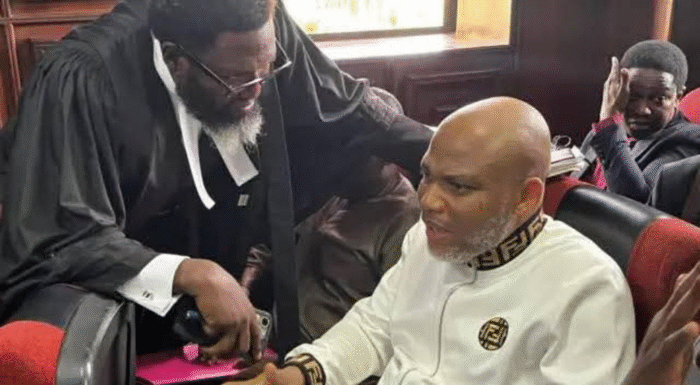
Also addressing journalists, one of Kanu’s legal consultants, Barr. Maxwell, clarified that Kanu is representing himself in court, while the lawyers present only serve as consultants.
He explained that during preparations for the defense, Kanu discovered that the section of the Criminal Code forming the basis of his charge does not exist, prompting a motion challenging the legality of the charge.
“This is simple: if a person is brought before a court, he must be told the law he has broken. You cannot ask someone to defend himself under a law that is not in existence. Section 36(12) of the Constitution forbids that,” Maxwell said.
He faulted the court’s initial position that the issue concerns conviction rather than charge validity.
“You cannot talk about conviction without trial, and you cannot talk about trial without a valid law in existence. The issue must be heard first,” he stressed.
Responding to questions on why Kanu had earlier taken a plea, Maxwell explained that an objection to jurisdiction or legality of charge can be raised at any stage, including after prosecution witnesses have testified.
“The law is clear — such an objection may be raised before trial, during trial, or even after the prosecution closes its case. What Kanu is saying is simply: tell me the law upon which I am being tried.”
The defense insisted that unless the legality of the charge is settled, compelling Kanu to proceed to defense amounts to denial of fair hearing.
The matter is expected to continue tomorrow, where the court may decide whether to hear the motion or proceed with defense, amid heightened tension among supporters and observers




Comments 1