

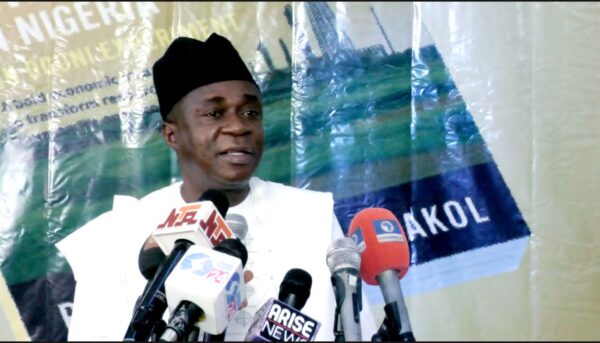
Nigeria’s first Professor of Capital Market, Prof. Uche Uwaleke, has praised a new book that proposes a simple but powerful solution to Nigeria’s long-standing poverty and resource-management problems. He delivered the review during the public presentation of “The Living Secret: Endowment for Development in Nigeria – An Ogoni Experiment”, written by prominent development economist and former presidential adviser, Prof. Magnus Kpakol.
Uwaleke described the 272-page book as a courageous, practical and morally grounded contribution to Nigeria’s development journey. According to him, the book goes beyond Ogoniland and provides an economic model that can work for all parts of Nigeria and even other African countries.
Speaking in clear terms, he noted that the book exposes why many resource-rich communities remain poor. He said the author makes the case that Nigeria is not poor because it lacks natural resources, but because communities have been denied access to the wealth within their land. He emphasized that misgovernance, exclusion and decades of dispossession are the real causes of poverty in places that should normally be prosperous.
A major highlight of the book is Prof. Kpakol’s proposed FLOW Model, which stands for Full Local Ownership. Uwaleke explained that the model simply suggests that communities should have full legal ownership of the natural resources located within their land, while the federal government continues to earn revenue through an 80 percent tax on production. He described the idea as a win-win system that empowers communities, maintains national unity and keeps government revenue stable.

Uwaleke said the book is divided into two broad parts. The first part explains the historical and economic reasons resource-rich regions remain underdeveloped, revisiting issues such as colonial exploitation, the legacy of the slave trade and the long struggle of the Ogoni people. The second part expands the discussion to issues of poverty, corruption and national development, showing how the FLOW Model can strengthen democracy, improve accountability and support investment in key sectors such as power and infrastructure.
He praised the book for its originality, noting that it offers not just theory but a workable plan involving community trust funds, development corporations and legal reforms that can be implemented. According to him, the book reframes Nigeria’s challenges by placing communities at the center of development and offering a template that other African countries can adapt.
In his conclusion, Uwaleke said the book is timely, insightful and a needed wake-up call for Nigeria. He urged policymakers, scholars, community leaders and development partners to study the work, stressing that Nigeria’s true prosperity lies not abroad but in the potential of its people and natural endowments.


I never thought about it that way before. Great insight!
I’m definitely going to apply what I’ve learned here.