

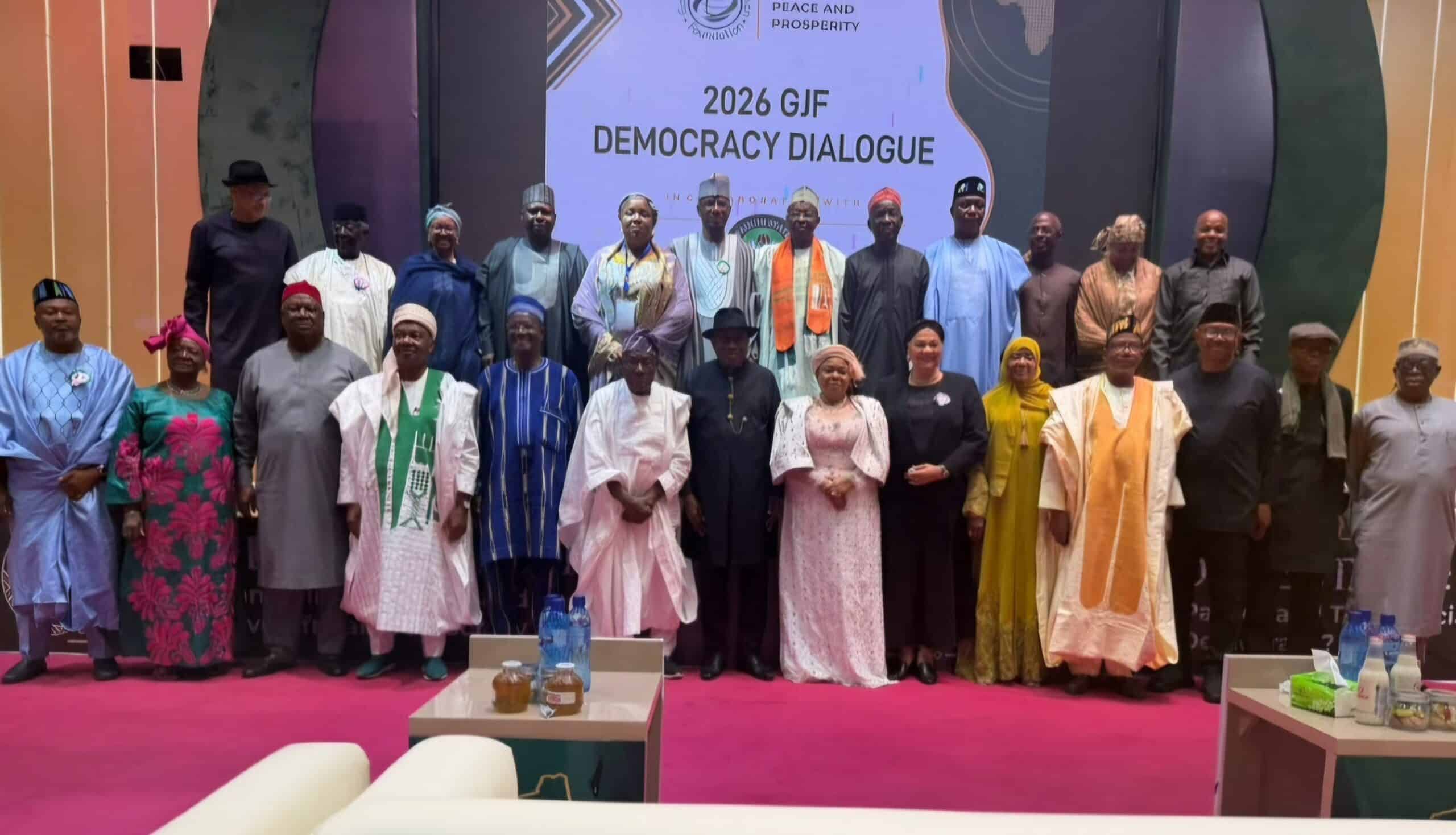
Former President Goodluck Jonathan has warned that weak political parties and compromised democratic institutions could undermine democracy across Africa, urging political parties and the judiciary to strengthen their roles in protecting the will of the people.
Jonathan, Chairman of the Goodluck Jonathan Foundation (GJF), gave the warning on Tuesday at the closing of the 2026 GJF Democracy Dialogue in Bauchi, held under the theme, “Beyond Elections: Can Political Parties and the Judiciary Save Africa’s Democracy?”
The former president said African political parties must evolve into genuine democratic institutions by embracing internal democracy, producing credible leaders, respecting their own rules and placing national interests above partisan considerations.
“Strong democracies cannot emerge from weak political parties,” Jonathan said, calling for stronger regulatory frameworks to improve political accountability and democratic integrity across the continent.
He cited Kenya’s model, which includes a dedicated institution for regulating political activities alongside the electoral management body, suggesting that other African countries could adopt similar mechanisms to strengthen accountability within the political system.
Jonathan also identified the judiciary as a critical pillar in the survival of democracy, saying it carries “an equally or more profound responsibility” in protecting democratic principles.
He urged judicial officers handling political and electoral disputes to uphold the principles symbolised by Lady Justice, particularly impartiality, fairness and the rule of law.
The former president expressed concern over the growing tendency in some African countries for electoral contests to be settled in courtrooms rather than through the ballot box.
While acknowledging the constitutional responsibility of the judiciary to resolve electoral disputes, Jonathan said democracy is strongest when the freely expressed will of voters is clear, respected and accepted.
“The courtroom should not become the arena where political mandates are routinely determined,” he warned.
Jonathan identified eight cardinal pillars on which functional democracy must rest: sovereignty of the people, the rule of law, separation of powers, protection of fundamental rights and freedoms, accountability and transparency, free and credible elections, political pluralism, and an active civil society.
He cautioned that although no country could achieve perfection across all eight pillars, substantial compliance was essential for democracy to remain stable and sustainable.
“When several of these foundations of democracy are weakened, what emerges is not genuine democracy but a pseudo-democracy; one that retains democratic forms while steadily losing democratic substance,” he said.
Jonathan therefore urged African leaders to deliberately strengthen political parties, legislatures, executives and judiciaries around democratic principles, warning that the survival of democracy should be measured by the strength of institutions rather than the frequency of elections.
“History will judge our democracies not by the number of elections we conduct, but by the strength of the institutions we build and the fidelity with which we uphold these democratic pillars,” he said.
He called on African countries to break away from the recurring cycle of political instability and electoral crises by building strong institutions capable of promoting peace, development and shared prosperity.
Jonathan commended the Bauchi State Government and Governor Bala Mohammed for supporting the democracy dialogue. He also thanked former President Olusegun Obasanjo and other participants for attending the event.


it is a exclusive-web page