

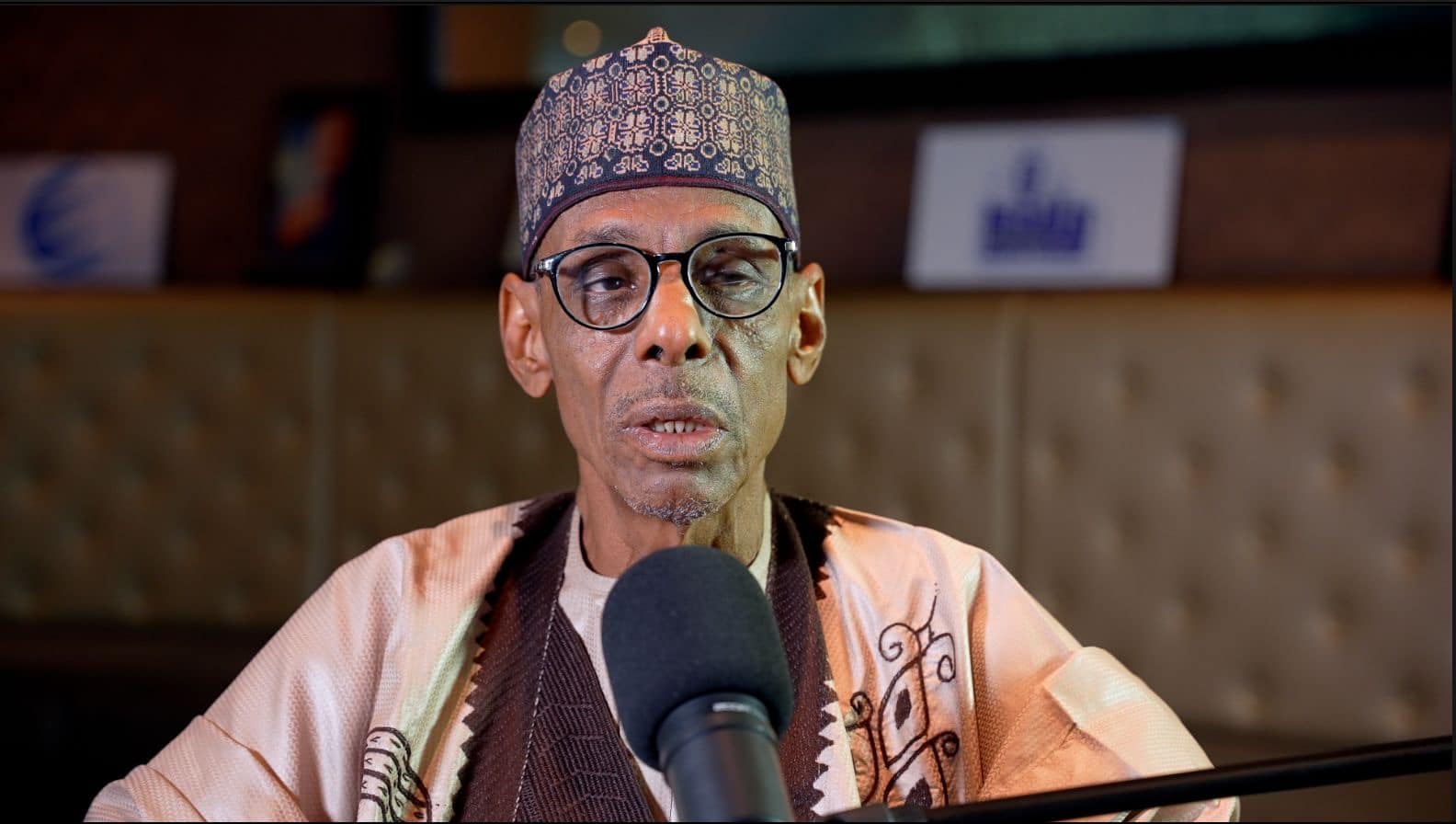
The Chairman of the People’s Redemption Party (PRP), Dr Baba Ahmed, has blamed successive northern leaders for the worsening insecurity, poverty and educational decline in the region, declaring that “the North is finished” unless its political leadership urgently changes course.
Ahmed, a former Federal Permanent Secretary, made the remarks during an interview on Naija Unfiltered on Symfoni Television, where he assessed Nigeria’s political leadership, the state of democracy and the challenges confronting the North ahead of the 2027 general elections.
According to him, the North has suffered a dramatic reversal from the era when political leaders prioritised education and invested heavily in developing human capital.
He recalled that generations of northern children benefited from free education and government support, arguing that the region’s earlier leaders understood that education was essential to closing the development gap.
Hammed cited the story of a Christian child who reportedly emerged as the best student in Northern Nigeria in 1962. He said the then Premier of Northern Nigeria, Sir Ahmadu Bello, personally visited the boy in his community and supported his ambition to become a Catholic bishop.
The PRP chairman said the story demonstrated the inclusive approach to education adopted by some northern leaders at the time, stressing that religious or ethnic considerations did not prevent talented young people from receiving opportunities.
He contrasted that period with the current situation, in which the North has some of Nigeria’s highest levels of out-of-school children, poverty and insecurity.
Baba Ahmed also criticised the current system of educational quotas and what he described as the lowering of admission standards in an attempt to address perceived educational disadvantage.
He argued that rather than lowering standards, governments should have invested in improving access to quality education and creating opportunities for children from disadvantaged communities to compete on equal terms.
According to him, northern leaders failed to sustain the vision of their predecessors and should take responsibility for the region’s present condition.
He also pointed to the historical development of Ahmadu Bello University and the School of Basic Studies as examples of how deliberate government intervention could transform educational outcomes.
Baba Ahmed said the School of Basic Studies was created to address the shortage of qualified northern students seeking admission into universities, eventually producing large numbers of graduates who went on to contribute to the region and the country.
He recalled that hundreds of students were admitted into his own set and most eventually progressed into degree programmes, regardless of their social background.
The former permanent secretary said the lesson for contemporary leaders was that governments could still transform society if they placed the interests of poor and disadvantaged citizens ahead of political interests.
He particularly criticised northern governors for allegedly prioritising political survival and alignment with the Federal Government over addressing the insecurity and socioeconomic challenges affecting their people.
Hammed noted that most northern governors belong to the governing All Progressives Congress (APC), arguing that this has weakened the region’s ability to demand accountability from the Federal Government.
He said northern political leaders should stop blaming other parts of the country for the region’s problems and instead engage in honest self-examination.
“If the North wants to fix itself, the North needs to speak to itself,” he said, urging leaders to confront failures in education, security, population management and economic development.
Hammed also criticised President Bola Tinubu’s administration, describing it as “quite possibly the worst” Nigeria has had and arguing that the President should not seek a second term.
He said the government had become disconnected from the realities facing ordinary Nigerians, particularly concerning hunger, insecurity and poverty.
The PRP chairman further condemned what he described as the growing weakness of Nigeria’s democratic institutions. He accused the National Assembly of abandoning its oversight responsibilities and becoming too closely aligned with the executive.
He also raised concerns about the judiciary and the potential impact of court decisions on opposition parties and the 2027 elections.
On the political future of the country, Hammed said opposition parties must cooperate if they hope to defeat the APC in 2027. He argued that no single opposition party could easily overcome the governing party without strategic collaboration.
He disclosed that the PRP supports efforts by opposition groups to develop a common strategy, adding that several options, including the possibility of a single opposition candidate, were being considered.
Baba Ahmed said the greatest threats to the 2027 elections included possible electoral interference, violence before and after the elections, judicial decisions affecting candidates and the use of state resources to influence voters.
Despite his criticism of the country’s political leadership, he said he remained optimistic about Nigeria’s future, insisting that the country could recover if Nigerians demanded better leadership and rebuilt institutions around accountability, competence and service.
He maintained that Nigeria’s current crisis could not be resolved without confronting the quality of leadership across all levels of government.
“You can never get good out of bad,” he said, stressing that the country needed to rethink its political system and begin making decisions with future generations in mind.


