

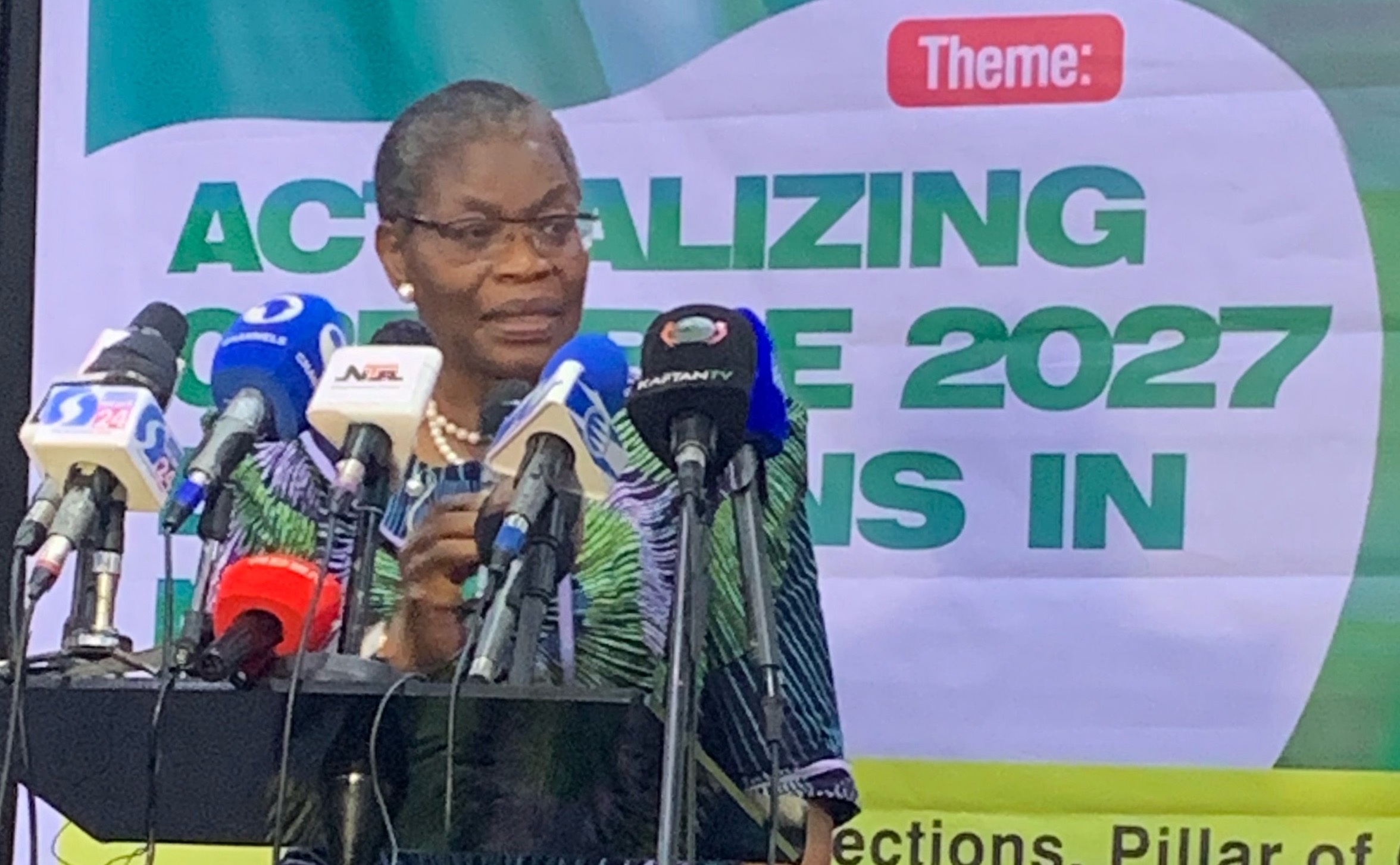
Former Minister of Education and convener of the Movement for Credible Elections (MCE), Dr. Oby Ezekwesili, has warned that Nigeria’s democracy is sliding into dangerous decline, insisting that citizens must take responsibility for defending it.
Speaking on Monday at the Movement’s Emergency Stakeholders Engagement in Abuja, Ezekwesili said the 2023 general elections exposed a deep crisis of legitimacy, citing extremely low voter participation.
She noted that only about 23 per cent of registered voters participated in the presidential election that produced the current administration, arguing that the figure falls far below both African and global democratic averages.
“As a matter of fact, by 2023 when only 23% of registered voters participated in the presidential election, it was very clear that we had departed from even the low African average of about 47%,” she said. “We are less than a third of voter participation globally.”
Ezekwesili attributed the decline to growing distrust in institutions responsible for managing elections, warning that Nigeria’s democratic system is “edging toward collapse” based on global indicators of democratic health.
She also raised concern over what she described as increasing abuse of state power against dissenting voices, including political opponents and citizens critical of government actions.
“One major crisis is the increasing use of state power against dissenting voices,” she said. “Whether political or civic, repeated cases of intimidation and harassment are deeply troubling.”
According to her, such developments threaten democratic stability, which depends on citizens’ freedom of expression and participation without fear.
Ezekwesili warned that rising fear ahead of the 2027 elections could further weaken civic engagement and deepen public apathy.
She criticised what she described as a growing culture of individualism among Nigerians, arguing that many only react when governance failures directly affect them.
“There is a tendency for people to say, ‘Nigeria has happened to me,’ only when it personally affects them,” she said, adding that this weak sense of collective responsibility has undermined national accountability.
The former minister said the gathering was aimed at building citizen solidarity to prevent democratic collapse, stressing that democracy belongs to the people, not politicians.
“This is citizens’ work,” she said. “We are here because we must save our country. If we don’t care about ourselves, at least care for our children.”
Ezekwesili further argued that Nigeria’s political system has been captured by a class of politicians who prioritise power over governance, regardless of party affiliation.
According to her, repeated failures across administrations point to a deeper problem of political class dysfunction rather than party-specific failures.
She said credible democracy depends on transparent elections, equal competition, and public trust in institutions such as the electoral commission, judiciary, and security agencies.
However, she alleged that these institutions have been weakened by political interference, inconsistent judicial decisions, and alleged misuse of security forces during political processes.
Ezekwesili also referenced long-standing demands for electoral reforms, particularly on electronic transmission of results, insisting that citizens have repeatedly called for greater transparency.
She maintained that resistance to reform reflects reluctance by the political class to strengthen accountability systems.
The former minister also highlighted the activities of the Movement for Credible Elections, including advocacy campaigns and protests such as the “Occupy National Assembly” movement, during which participants were allegedly dispersed with tear gas.
She urged Nigerians to move beyond dialogue and take collective action to demand electoral integrity and accountability.
“Democracy does not belong to politicians,” she said. “Democracy belongs to the citizens of every country that chooses to be democratic.”
The forum was attended by political actors, civil society groups, and women’s organisations including NAWOJ, all of whom raised concerns about Nigeria’s democratic trajectory ahead of the 2027 general elections.
Former Labour Party presidential candidate, Peter Obi, represented by Obidient Movement leader Yunusa Tanko, expressed concern over the ongoing voter registration process, alleging possible disenfranchisement of eligible voters, particularly in the South-East.
He called for urgent electoral reforms and stronger citizen participation to protect the credibility of future elections.
Oyo State Governor, Seyi Makinde, represented at the event, said credible elections remain essential to national security and stability, warning that declining public trust in democracy could fuel unrest.
Meanwhile, Social Democratic Party presidential candidate, Adewole Adebayo, accused President Bola Ahmed Tinubu’s administration of attempting to dominate political institutions and weaken opposition parties through intimidation.
African Action Congress leader, Omoyele Sowore, also criticised Nigeria’s political system, describing it as controlled by entrenched elites determined to retain power.


