

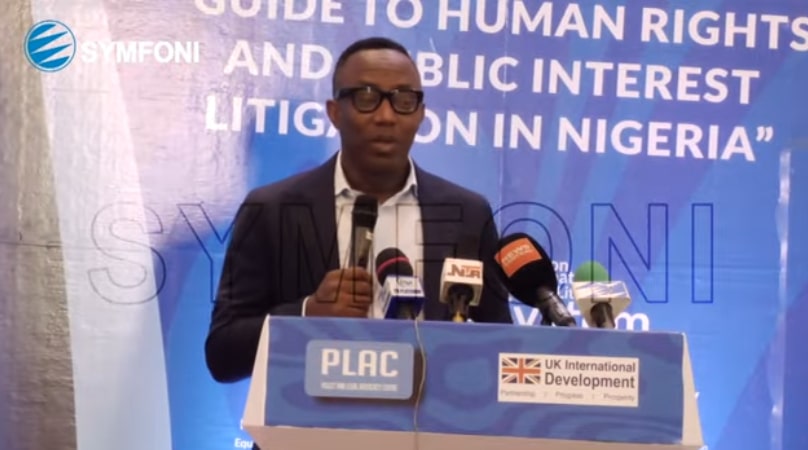
Nigeria is currently facing growing concerns over the state of human rights and the role of the judiciary, as activist Omoyele Sowore has alleged that the legal system is increasingly being used as a tool to suppress public participation in democracy.
Speaking at a public event focused on human rights and public interest litigation, Sowore questioned whether the Nigerian legal profession is truly serving the public interest or aligning with other powerful interests. He acknowledged that while the legal system has made contributions to public interest, more effort is needed to ensure justice is effectively delivered.
According to him, recent trends in the judiciary are troubling. He pointed to cases where individuals or lawyers who approach the courts on matters of public interest are treated as “meddlesome interlopers.” In some instances, he noted, courts have imposed punitive fines on lawyers who file such cases, a development he described as unacceptable.
Sowore also highlighted challenges in enforcing fundamental human rights in Nigeria. Despite what he described as an “avalanche of laws” designed to protect citizens, he said the real-life experience of those seeking justice tells a different story. He explained that legal processes, especially in cases involving unlawful detention, are often delayed by administrative and procedural obstacles, making it difficult for victims to get timely relief.
He further called on the judiciary, particularly judges, to exercise caution in delivering rulings that may be perceived as going against public interest. According to him, public trust in the justice system depends heavily on how fairly and transparently such cases are handled.
A major concern raised during his remarks was the growing use of what he described as “lawfare” — the strategic use of legal systems to weaken or silence political opposition and limit democratic participation. Sowore warned that this trend could significantly affect Nigeria’s democracy, especially as the country approaches future elections.
He alleged that some individuals and political actors are being prevented from participating in the democratic process through legal tactics, adding that many of these cases may eventually reach higher courts, including the Supreme Court.
Drawing from his personal experiences, Sowore described himself as a frequent victim of such legal battles, stating that he often finds himself dealing with arrests and court cases. He emphasized the importance of legal resources that empower ordinary citizens to understand and defend their rights without relying entirely on legal professionals.
In addition, he criticized what he sees as a disconnect between lawyers and their clients in cases involving rights violations. He expressed concern that some lawyers fail to strongly challenge unjust decisions in court, instead showing excessive deference even when their clients’ rights are at stake.
Sowore also questioned the fairness of certain legal frameworks, including the Administration of Criminal Justice Act (ACJA), suggesting that laws created by elite legal practitioners may not always reflect the realities faced by ordinary Nigerians.
Beyond immediate legal reforms, he called for a broader conversation around “historical justice” — addressing past human rights violations and holding perpetrators accountable, even long after the incidents occurred. He argued that without accountability, a culture of impunity will continue to thrive.
Referencing global precedents, he noted how countries involved in historical injustices such as slavery have been confronted with demands for accountability. He suggested that Nigeria should also develop mechanisms to address past abuses and ensure justice for victims.
The event, which brought together legal practitioners and civil society groups, highlighted the urgent need for reforms aimed at strengthening human rights enforcement and restoring public confidence in the judiciary.
As debates around governance, democracy, and the rule of law continue, Sowore’s remarks add to the growing calls for a more transparent, accountable, and citizen-focused legal system in Nigeria.


