

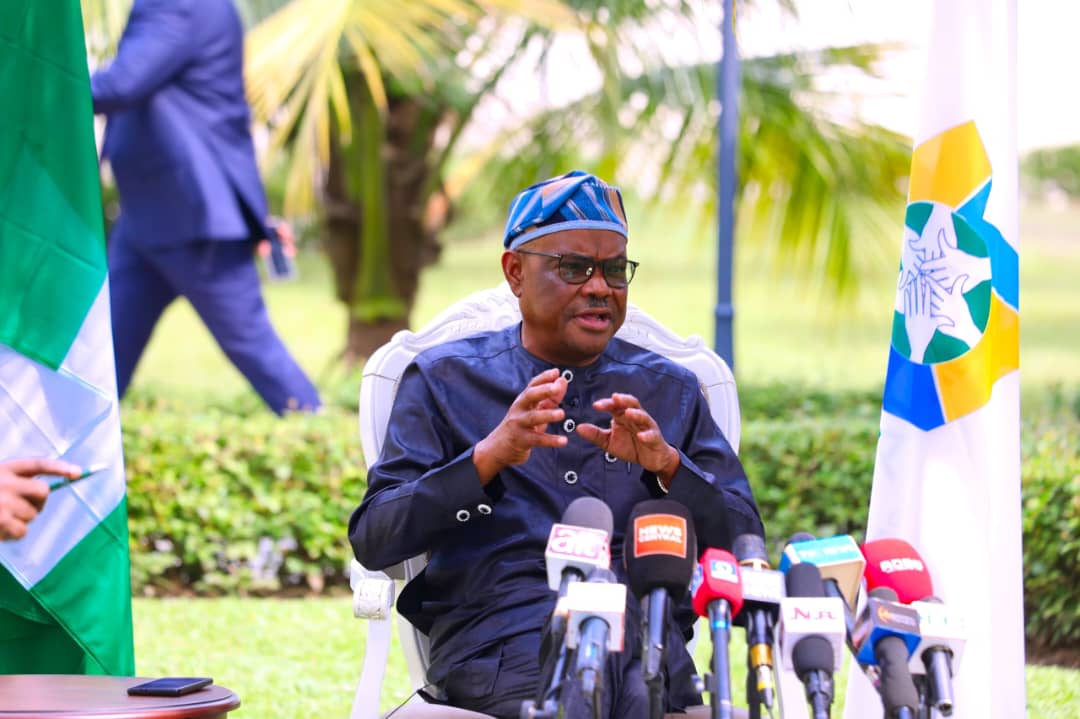
The Minister of the Federal Capital Territory, Nyesom Wike, has claimed that Peter Obi’s emergence as the Labour Party presidential candidate in 2023 helped split votes that could otherwise have gone to Atiku Abubakar, contributing to President Bola Tinubu’s victory.
Wike made the remarks on Wednesday while discussing his determination to support Tinubu’s re-election bid in 2027.
President Tinubu of the All Progressives Congress won the February 2023 presidential election with 8,794,726 votes. Atiku of the Peoples Democratic Party came second with 6,984,520 votes, while Obi polled 6,101,533 votes to finish third.
The three politicians are expected to feature prominently again in the 2027 presidential race.
“Look at the entire votes of Obi that would have gone to Atiku, all gone,” Wike said, arguing that Obi’s candidacy weakened the PDP’s chances.
The former Rivers State governor also claimed that Obi was deliberately allowed to gain support in parts of the South-South because he was not considered a major threat to Tinubu’s chances.
“The South-South ought to be a PDP stronghold that would have made Atiku win the election. In Cross River, we said support Obi. APC took second in the state. In Edo, they supported Obi,” Wike said.
“Then in Rivers State, since I am here, we said no to Obi and Atiku. We supported the President.”
Wike further dismissed suggestions that Obi’s popularity, particularly among young Nigerians, would automatically translate into electoral victory in 2027.
“When he appeared at the NBA conference, they’re shouting Obi. For you, he’s popular. When the proper mathematics comes to the table, we’ll know,” the FCT minister said.
His comments offer a fresh insight into the political calculations surrounding the 2023 election and underscore the battle already shaping up ahead of 2027.
Tinubu will seek re-election with the advantage of incumbency, although his administration faces criticism over the economy, cost of living and worsening security challenges.
Atiku, meanwhile, remains one of Tinubu’s strongest potential challengers but continues to face questions over past corruption allegations and his long association with Nigeria’s political establishment.
Obi, who retains significant support among young voters and sections of the urban population, is also expected to remain a major factor in the 2027 contest.
Wike’s latest remarks, however, suggest that political alliances and regional vote calculations rather than popularity alone could once again play a decisive role in determining the outcome of the next presidential election.


