

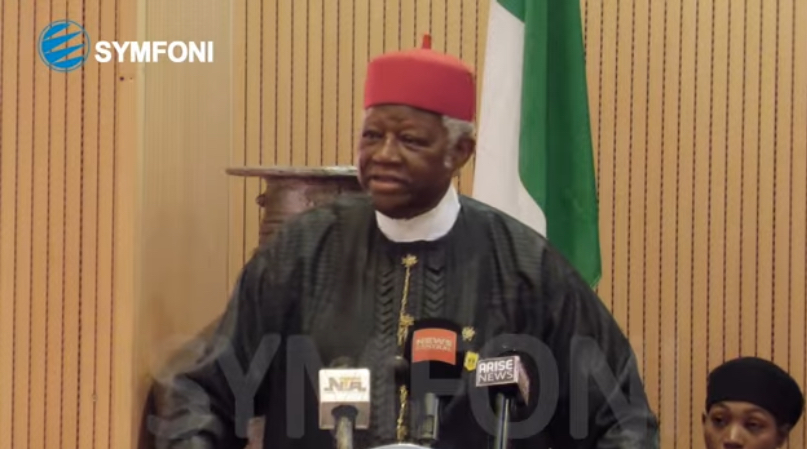
Former Minister of Foreign Affairs, Ike Nwachukwu, has exposed deep-rooted challenges in Nigeria’s foreign service, explaining why many young diplomats are unable to rise to the rank of ambassador despite years of training and service.
Speaking at a recent event, Nwachukwu warned that the growing politicisation of ambassadorial appointments has created a system that sidelines career diplomats, leaving them frustrated and unable to achieve the peak of their profession.
According to him, successive governments have increasingly prioritised political appointees over trained foreign service officers, effectively shutting out professionals who dedicate their lives to representing Nigeria on the global stage.
“It is not right,” he said, stressing that young men and women who join the service with the ambition of becoming ambassadors are now forced to retire without ever attaining that goal.
The former minister pointed to the abandonment of the traditional 70–30 ratio, where 70 percent of ambassadorial positions were reserved for career diplomats and 30 percent for non-career appointees, as a major cause of the crisis.
“In my time, we maintained that balance. We must return to it—or even adopt an 80–20 structure—to restore fairness and motivation,” Nwachukwu stated.
He warned that the current system discourages excellence and undermines morale within the foreign service, as officers see their career progression blocked by political interference.
Drawing from his military background, Nwachukwu likened the situation to a system where soldiers are prevented from rising through the ranks.
“When you join the military, your aim is to become a general. If that path is blocked, you leave feeling that the system has shortchanged you,” he explained.
Beyond staffing concerns, Nwachukwu also highlighted funding challenges that continue to weaken Nigeria’s diplomatic missions abroad.
He recalled that during his tenure, budgeting entirely in naira made it nearly impossible to run foreign missions effectively, prompting him to seek intervention from former military president Ibrahim Babangida.
Following that intervention, a dual budgeting system was introduced, with domestic operations funded in naira and foreign missions funded in dollars.
“You cannot fund foreign missions in naira and expect results abroad,” he said.
The elder statesman warned that inadequate funding exposes diplomats to financial pressures that could compromise Nigeria’s international image and integrity.
“When you expose people to temptation, only a few will resist it,” he cautioned.
Nwachukwu further called for the establishment of a Foreign Service Commission to oversee recruitment, ensure merit-based appointments, and protect the career progression of diplomats.
He urged the government to prioritise proper staffing, adequate funding, and institutional reforms to strengthen Nigeria’s global representation.


